Lazada Indonesia offers two main shipping options — Standard Delivery and GoJek (Express) — depending on seller and customer locations. Shipping fees for Standard Delivery vary based on multiple factors such as seller location, customer location, order value, and (assumed) package weight.
At the time of this project, customers received very limited guidance on how shipping fees were calculated. Some information appeared on the Product Detail Page (PDP), but the full cost was only revealed again at Cart or Checkout. This often resulted in unexpected shipping fees, especially for low‑value orders.
From a business perspective, Lazada was heavily subsidizing shipping costs, even for very small orders (below Rp 50.000). This created a significant cost burden. The company’s direction was to introduce shipping fees for low‑value orders while minimizing cart abandonment and, where possible, encouraging customers to increase basket size.
This case study describes how the product team approached shipping fee transparency by deeply understanding customer motivation, analyzing behavioral data, and delivering the right information at the right moment along the purchase journey.
section II
Design goals
Primary Goals
Reduce cart abandonment caused by unexpected shipping fees
Increase shipping fee transparency earlier in the journey
Business Objectives
Enable more granular shipping fee configurations
Reduce unnecessary shipping fee subsidies
Encourage customers to increase order value to reach free‑shipping thresholds
Product Metrics (Success Signals)
Higher address input rate
Lower checkout drop‑off rate
Increased AOV and basket size (by persona
Section III
Analyze the problems and identify opportunities
By looking at the ordering journey below, we have found some problems:
Key Pain Points
Shipping fees were unclear and fragmented across the journey.
Customers often optimized for item price only, without understanding total landed cost.
Shipping fee logic was complex and invisible:
Based on customer location
Dependent on order value thresholds
Free shipping applied only to Standard Delivery, not Express
Shipping fees were calculated differently at PDP vs Cart vs Checkout, creating surprises.
System & Policy Constraints
Free shipping threshold varied by customer location.
Shipping fee at Checkout was calculated on total order value, while earlier screens showed item‑level assumptions.
Multiple delivery options confused customers, especially first‑time users.
The combination of these issues led to:
High cart abandonment at Checkout
Inefficient shipping subsidies
Missed opportunities to increase AOV and basket size
User Insights
After conducting user interviews, we had 3 main simplified user personas
Jethro: Repeat customer from Kalimantan (Kalimantan Timur, Kota Samarinda) — far away from Jakarta
Logged in
Compare products and looking to score lowest price + shipping fees
Familiar with Lazada Shipping Fees
Lazada objective: help Customer finding the right SKU with certainty, no drop-off during checkout
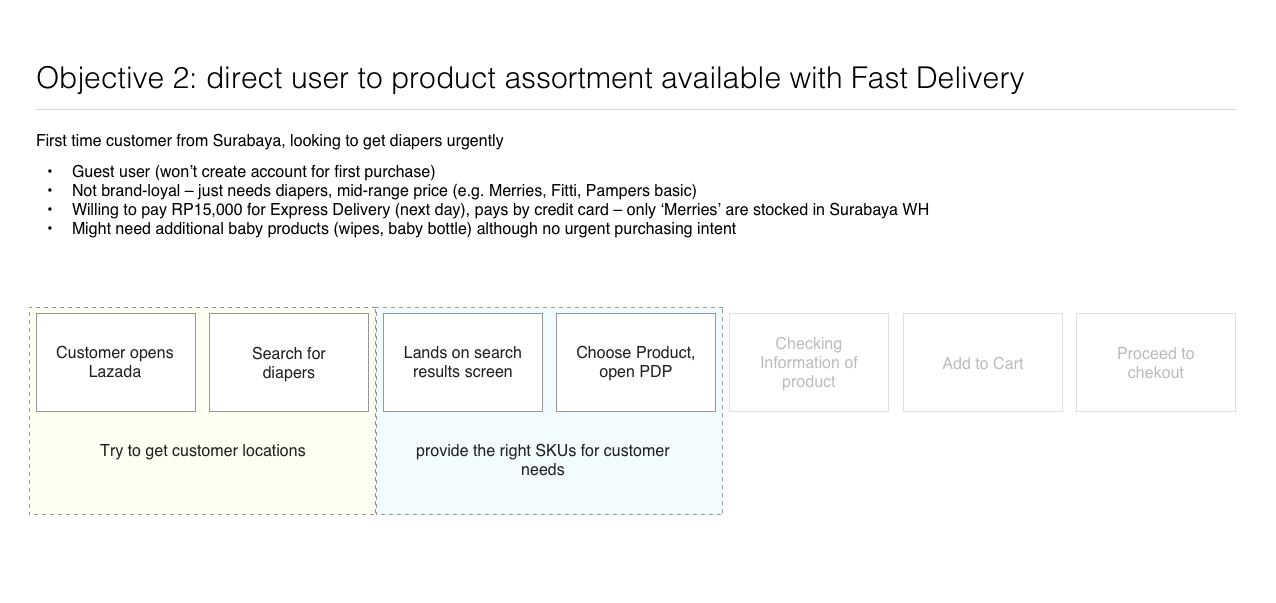
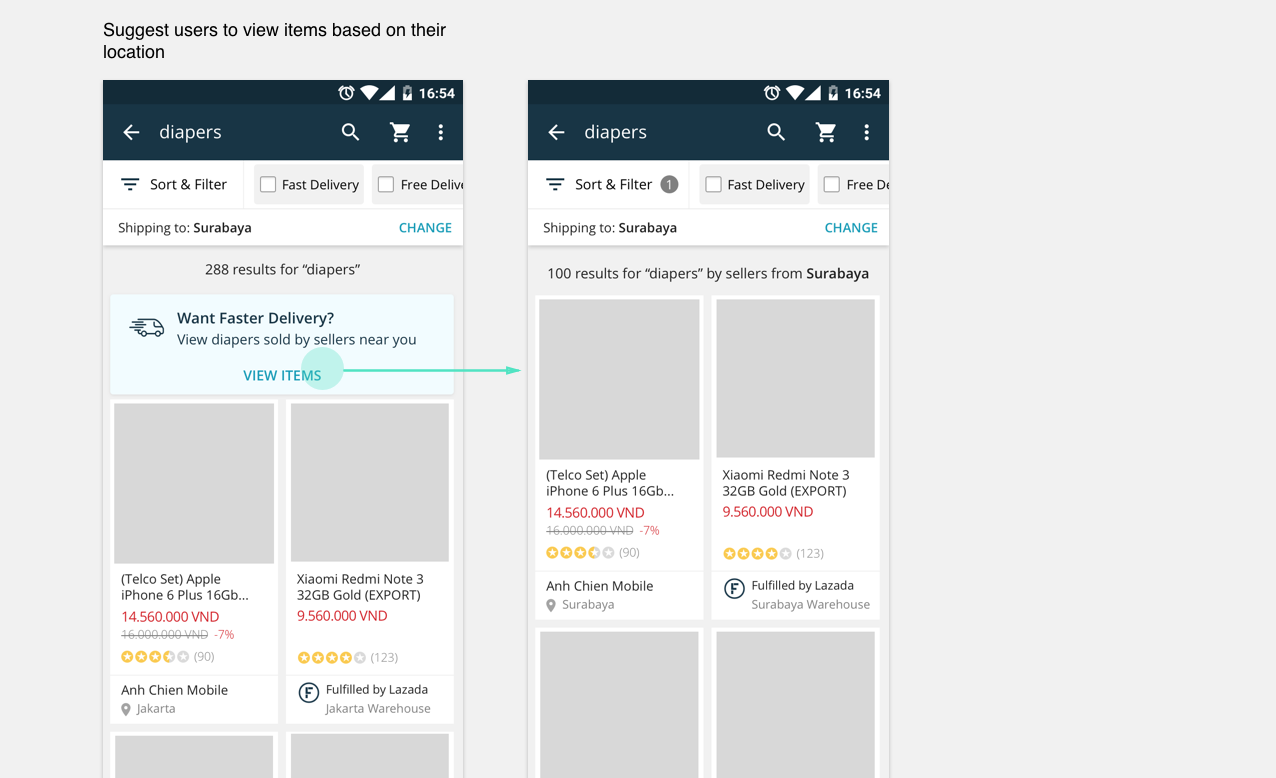
Eleazar: First time customer from Surabaya, looking to get diapers urgently
Guest user
Not brand-loyal — just needs diapers, mid-range price
Willing to pay more for Express Delivery (next day), pays by credit card
Might need additional baby products (wipes, baby bottle) although no urgent purchasing intent
Lazada main objective: direct user to diaper assortment available with Express Delivery (higher add-to-cart)
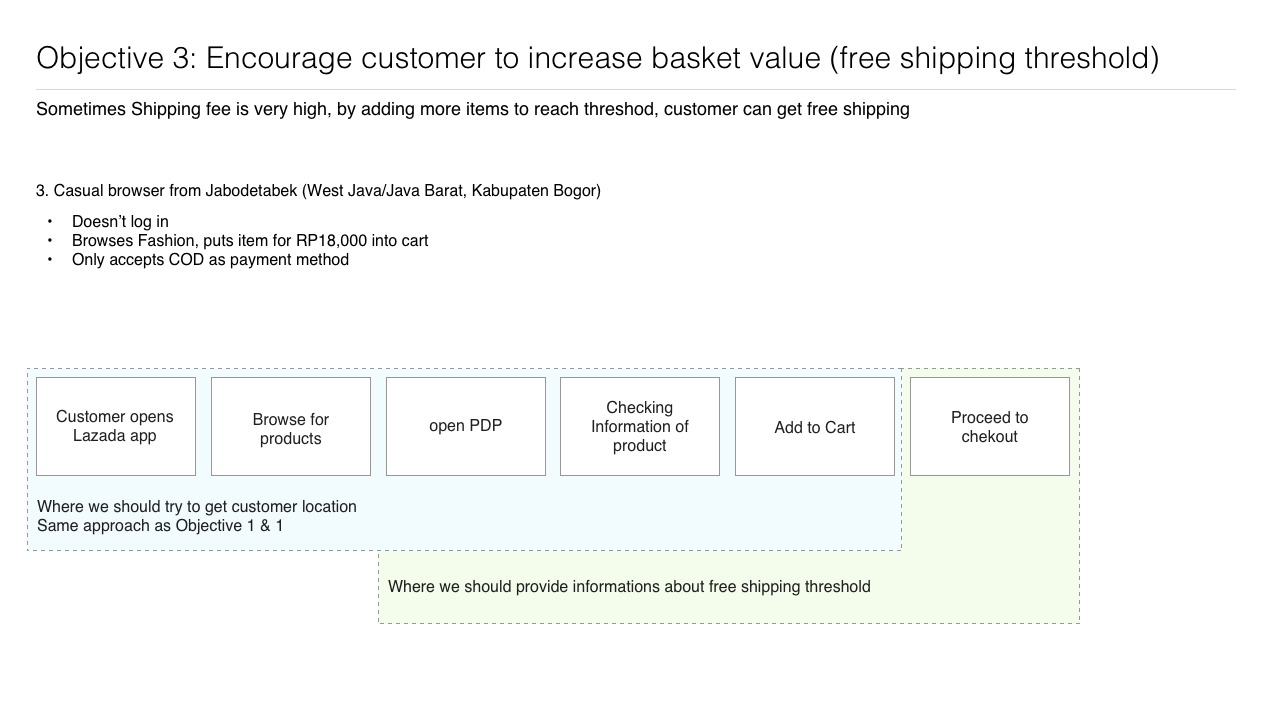
Suwandi: Casual browser from Jabodetabek (West Java/Java Barat, Kabupaten Bogor)
Doesn’t log in
Browse for low price products RP 50.000 — 100.000
Only accepts COD as payment method
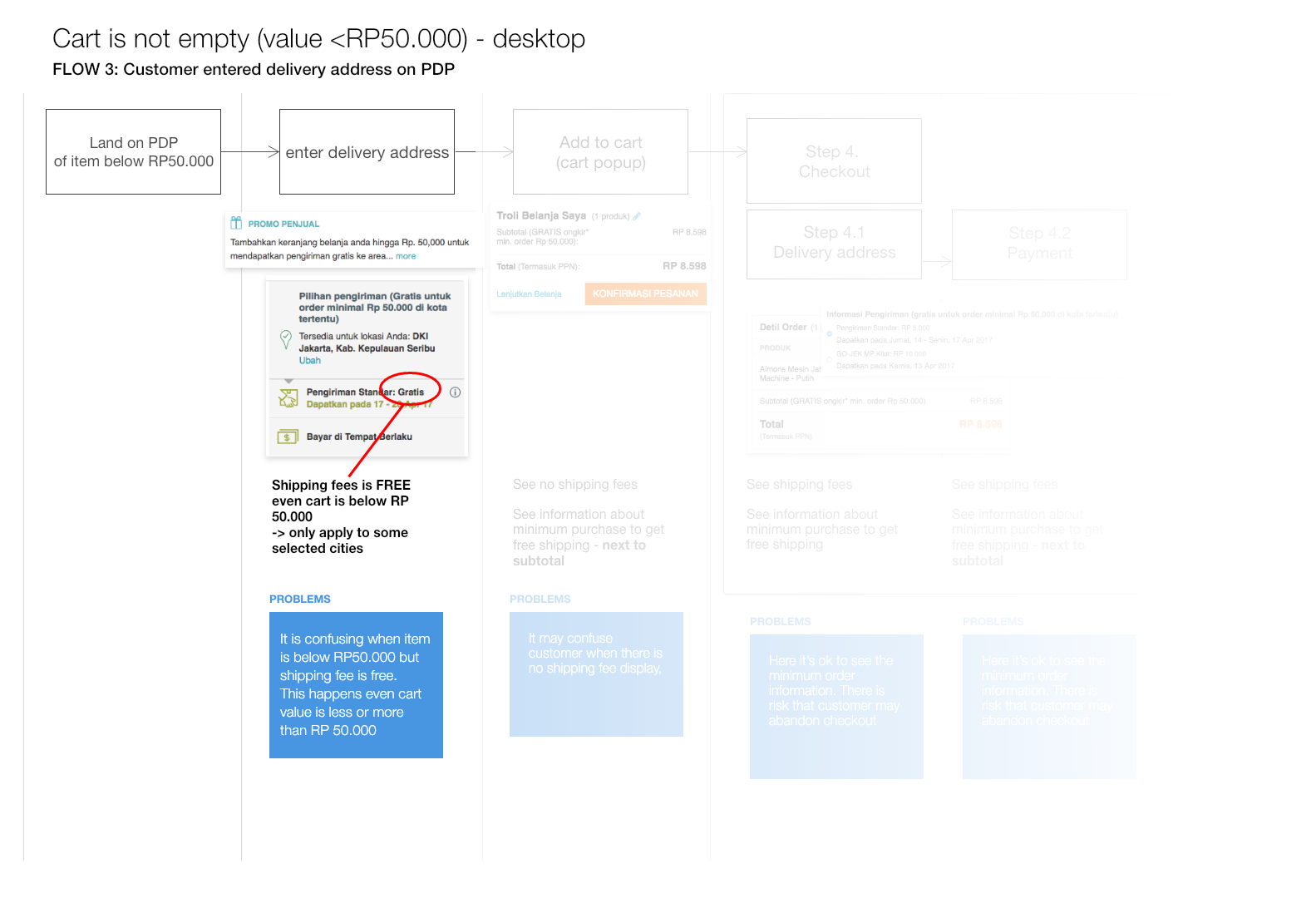
Lazada objective: encourage to increase basket value to >RP30,000 (higher AOV)
Section IV
Design Approach
Guiding Principle
Customer location is the foundation of shipping fee clarity.
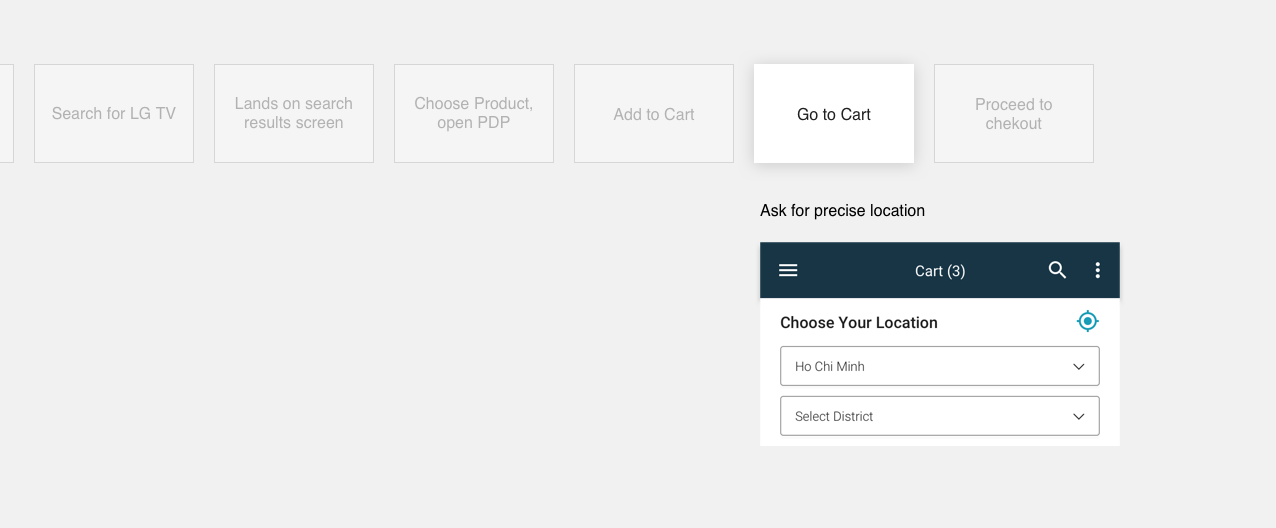
To provide meaningful guidance, Lazada needed to know the customer’s location as early as possible — without blocking the shopping experience.
Instead of forcing a single permission gate, we designed multiple contextual entry points to capture or infer customer location across the journey:
App entry / first visit
Search results and filtering
PDP (delivery information)
Cart (precise location confirmation)
The approach focused on:
Progressive disclosure of shipping information
Aligning information with user intent at each step
Supporting different customer motivations through personas
From the moment user lands on app or website
Following their journey
To the final steps
Section V
Solutions
Persona‑Driven Design
Case 1: Jethro — Repeat Customer from Kalimantan
Behavior & Motivation
Highly price‑sensitive
Optimizes for total landed cost (item price + shipping)
Familiar with Lazada mechanics
Design Opportunities
Help customers quickly identify SKUs with the lowest shipping cost
Reduce uncertainty before reaching Checkout
Solution
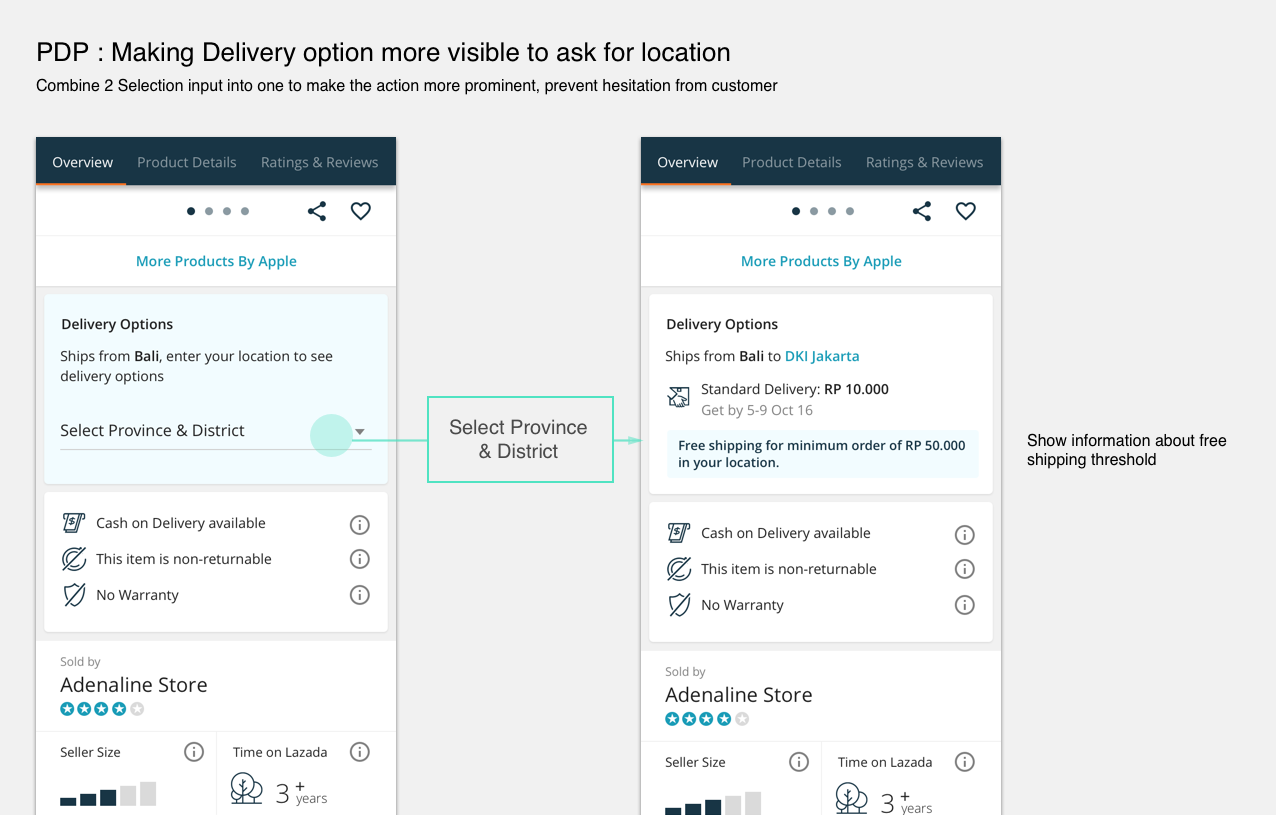
Display Free Shipping Threshold and delivery eligibility directly on the Product Detail Page
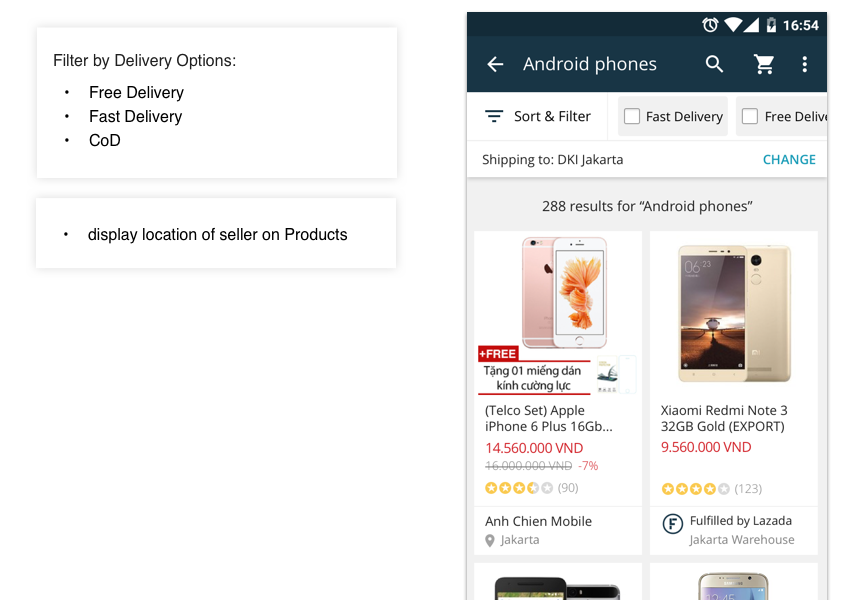
Surface seller location and delivery options earlier in Search Results
Allow filtering by delivery options (Free Delivery, Fast Delivery, COD)
Case 2: Eleazar — First‑Time Customer, Urgent Need
Behavior & Motivation
Needs diapers urgently
Willing to pay more for Express Delivery
Open to adding complementary items
Solution Direction
The same approach to get user location and provide the right SKUs, but also have a smart filter methods to let user quickly looking for products with faster delivery
Prioritize assortments available with Express Delivery
Clearly communicate delivery speed and fees upfront
Encourage basket expansion with relevant add‑ons
Case 3: Suwandi — Casual Browser, COD Only
Behavior & Motivation
Browses low‑value items
Very price‑sensitive
Limited trust (COD only)
Solution Direction
Encourage basket value increase to pass shipping thresholds
Explain shipping fee rules more clearly
Display Free Shipping Fee threshold on PDP
Encourage Customer to add more product after adding to cart
Continue encouraging customer to add more items to get free shipping - reduce cart abandon
Measured behavioral shifts before and after changes
Key Outcomes
Customers entered their addresses more frequently and earlier
Checkout surprises were reduced
Clear differentiation in impact by persona:
Case 1: Better SKU discovery, but assortment limitation exposed in rural or remote areas.
Case 2: Strong uplift in completed orders. We saw a big increment in orders placement.
Case 3: We didn't see much improvement on the number of items in the basket, nor any steady data about how customers understand the shipping fees, so for this case we need to run a deeper user research and see more carefully how customer interact with this new features, since this case has been the major case in ID, and Vietnam also (where customers bought very cheap items).
Long‑Term Impact
This project represented the first phase of Lazada’s Shipping Fee Transparency initiative. The learnings were later extended and adapted to other markets, including Vietnam, Thailand, and the Philippines, where low‑value orders and shipping sensitivity were also critical challenges.
The team continued iterating on shipping communication, balancing cost efficiency with customer trust and clarity.
Table of Contents
Close
Other works at
Lazada
Biggest E-commerce platform acquired by Alibaba in 2018, operating in Singapore, Indonesia, Malaysia, Vietnam, Thailand, Philippines.